The Country Craft Label That Promises More Than It Says
A country craft label can say handmade or local without explaining much. Learn what to ask so you can understand who made an item and where its materials came from.
The most common mistake with a country craft label is treating a reassuring word as a full account. “Handmade” and “local” may describe something real, but without details they can leave you unsure who shaped the item or where its wood, wool, clay, or metal originated.
A label is useful when it connects the finished piece to people, materials, and place. These questions help you read one without demanding a life story from every maker.
1. What does handmade mean?
“Handmade” can refer to very different amounts of human work. A maker might cut, shape, assemble, and finish each object by hand. Another might design a product and hand-finish parts made with a mould or machine. Both descriptions may be accurate, but they tell a customer different things.
Look for a verb rather than an adjective. “Thrown on a wheel,” “woven on a hand loom,” “forged,” “sewn,” or “assembled and finished here” gives a clearer sense of the work. A short account can also name a division of labour: one person might mill timber while another makes the stools.
This is not a demand that every maker do every task. It is a way to distinguish the work being claimed from the work being assumed. If the label says only “handmade,” ask what part of production that word refers to.
2. Which part is local?
“Local” could describe the maker’s workshop, the source of the materials, the place where the item was assembled, or the market where it is sold. Those are separate facts. A basket woven in a village from imported reed has a local maker, but the reed has a different origin.
Notice the nouns around the claim. “Made in the valley” is a statement about making; “valley-grown willow” is a statement about material. If a label does not say which one it means, a courteous question can clarify it: “Is the local part the workshop, the material, or both?”
Place names can also be broad. A county, region, and village each offer a different level of detail. A maker need not disclose a home address; naming a workshop town or sourcing area may be enough to make the claim intelligible.
3. Trace each material
Many craft pieces bring together materials from more than one source. A wooden frame may use locally felled timber and bought-in hinges. A knitted item may combine regional fleece with commercially spun yarn. A clear label identifies the significant components instead of letting one local ingredient stand for the whole object.
Material descriptions can be practical rather than elaborate. Ask what the material is, where it came from, and whether it was processed nearby. “Oak from a nearby sawmill” says more than “natural wood”; “wool from a neighboring farm, spun off-site” separates the farm source from the later processing.
Where origins are uncertain, careful wording matters. A maker who knows the timber was bought through a local supplier but not where the trees grew can say exactly that. Uncertainty honestly bounded is more informative than a sweeping claim.
4. Separate making from finishing
A finished object may pass through several hands. One person may cut leather, another stitch it, and a third apply a finish. A workshop might also buy standard components and turn them into a distinctive product. None of these arrangements automatically makes the object less worthy; the label should simply make the arrangement legible.
Listen for the difference between “made by” and “designed by.” Design describes decisions about form and function, while making describes physical work. A maker may do both, or coordinate a small group. When a product is collaborative, naming the roles gives customers a better picture than attaching one name to every task.
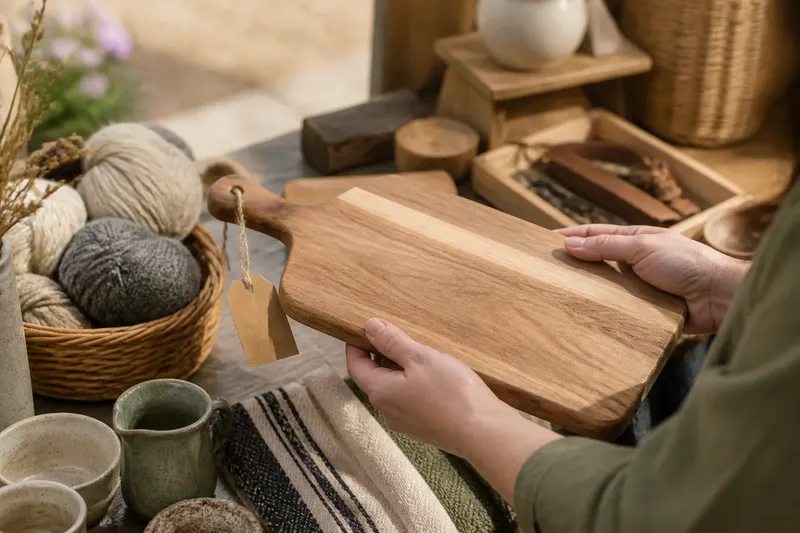
Say you are considering a wooden serving board at a village fair. The tag says “handmade locally,” and the seller explains that a local craftsperson shapes and oils the board from timber bought at a nearby yard, but cannot confirm where the tree was felled. You now know who did the finishing and where the timber was purchased, while the forest origin remains open. That is a useful, bounded account—not a reason to infer more than was said.
5. Read the claim’s boundaries
A strong label does not have to make the broadest claim. “Woven here from imported linen” is clearer than an unqualified “local linen cloth” if the linen itself was not grown or processed nearby. Boundaries help a reader understand what a claim includes and what it leaves out.
Pay attention to whether a label distinguishes a whole product from one component. A “locally made” garment might use imported cloth, while a locally sourced clasp or handle may be only a small part of an item made elsewhere. Look for wording that connects the place claim to the relevant stage.
It is not worth the effort to demand a complete chain of custody for a small purchase when the maker has already answered the question that matters to you. The useful standard is clarity about the claim being made, not exhaustive paperwork for its own sake.
6. Ask questions that invite specifics
Questions work best when they leave room for an honest, brief answer. “Who made this?” may be enough at a market stall. If you need more detail, ask about one part at a time rather than treating a conversation as an interrogation.
- Who did the shaping, sewing, weaving, or assembly? This identifies the hands-on work behind the finished piece.
- Which materials came from nearby? This separates material origin from workshop location.
- Where did the remaining materials come from? This can reveal whether the item combines local and outside inputs.
- Was any stage done by another workshop? This makes collaboration and subcontracted work easier to understand.
- What does “handmade” mean for this item? This asks the maker to define the label in concrete terms.
At a busy stall, a maker may not know every upstream detail. A straightforward answer such as “I buy the clay from a regional supplier, but I do not know where it was mined” gives you a boundary you can use. You can then decide whether that information is enough for your purpose.
7. Match detail to your decision
Different buyers care about different parts of a craft story. Someone choosing a gift may chiefly want to know who made it. A buyer seeking a particular material may need its composition and source. A local group ordering several pieces may need to understand which tasks can be done nearby and which depend on outside suppliers.
Decide what detail would change your choice before asking. If you care about the maker’s work, a clear production description may matter more than the origin of every fastener. If material provenance is central, the maker’s location alone will not answer your question. A label becomes useful when its information matches the decision in front of you.
Questions worth asking?
Does handmade mean every part was made by hand?
No single phrase tells you how much handwork went into an item. Ask which stages were done by hand and whether any components were bought ready-made.
Does local mean the materials are local too?
Not necessarily; the word may refer only to where the item was designed, assembled, or sold. Look for a separate statement about material origins.
What if the maker does not know where a material came from?
That gap does not make the rest of the account meaningless. A maker can still explain what is known, such as the supplier or processing location, and mark what remains uncertain.
How much detail should a small label include?
A label can be brief if it names the relevant work and place clearly. A card, conversation, or product page can supply extra detail when the object’s materials or production involve several stages.
Look for a legible account
The country craft label that serves a reader best is not necessarily the one with the warmest language. It is the one that distinguishes who made the piece, which stages took place nearby, and where the materials came from—while admitting when a detail is unknown.
When you see “handmade” or “local,” treat it as an invitation to identify the specific claim, not as proof of a whole production story. A few precise words can make the country craft label meaningful without asking it to promise more than the maker can say.