The Long Life of the Village Smithy
The village smithy connected metalwork with daily rural work; learn how its repairs, location, and changing trade shaped village life.
The most common mistake in remembering a village smithy is to picture a picturesque workshop set apart from ordinary life. A village smithy mattered because people could bring a broken hinge, worn shoe, or damaged tool to someone who understood both metal and the conditions of its use. When a repair was possible nearby, a household could avoid waiting for a distant supplier or changing how it carried out a task.
Work within reach
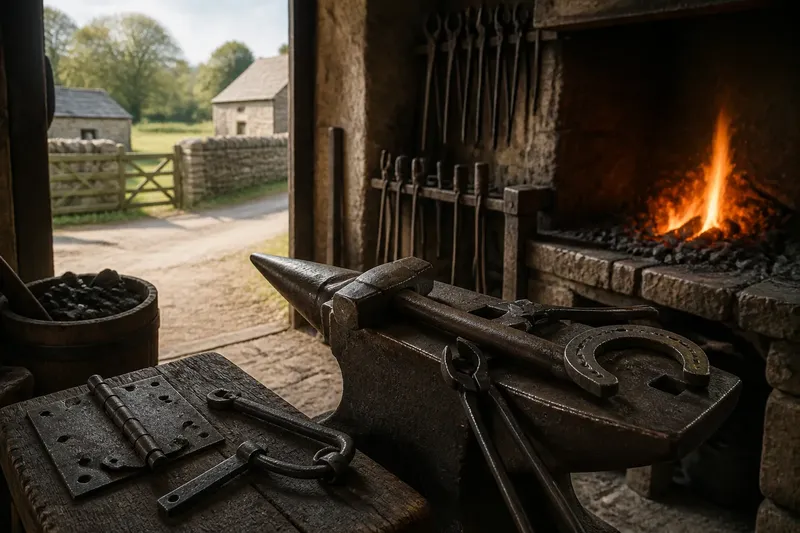
A forge was not simply where metal became objects. It was a local service point for turning a farmer’s, carrier’s, or household’s problem into something workable. The blacksmith heated iron in a fire, shaped it on an anvil, and used hammers, tongs, chisels, and punches to make or repair pieces suited to their purpose.
That work could range from a gate latch to a plow fitting, from a chain link to the ironwork on a cart. Some jobs called for new pieces; others depended on fitting, straightening, sharpening, or repairing what a customer already owned. The smith’s value lay partly in knowing how an object met the stresses of its daily use. A hinge had to swing; a tool edge had to meet soil or timber; a wheel fitting had to hold under movement.
For a rural household, this made the smithy a useful neighbor even when no one was buying a finished item. A farmer might bring a worn part in hand, describe where it had failed, and return to the field while the smith assessed whether it could be repaired. The exchange joined practical knowledge on both sides: the customer knew the conditions of use, and the smith knew how the metal might be reshaped.
The village smithy
The smithy’s location reflected the work. It needed an approach for people bringing bulky or awkward objects, space for fuel and tools, and a setting where heat, smoke, and noise could be managed. Being near a road or on the edge of a settlement could make arrival easier for farm carts and travelers while keeping the forge distinct from quieter domestic spaces.
Its familiar sounds and signs gave it a public character. The ring of hammer on anvil, the glow at the hearth, and a piece of work cooling nearby made the trade visible. A person passing through could see that something was being made or mended, even without entering the shop. The smithy became a landmark through repeated use, not ceremony.
Its social reach was often wider than its walls. People came with work to discuss, waited while a repair was judged, or passed on news as they collected an item. This did not make the forge a general meeting hall; its purpose remained work. But regular practical encounters gave it a place in village memory, much as a mill, wheelwright’s shop, or post office could become familiar through the errands that brought people there.
Skill in the repair
Forging is commonly associated with making something from raw metal, but repair was an equally telling part of the trade. Rural life gave tools and fittings repeated use, and replacement was not always the simplest answer. A smith could sometimes restore a bent or worn piece, adapt it to a particular task, or make a small component that was difficult to find elsewhere.
That kind of work asked for judgment as much as force. The smith had to consider the shape, thickness, and condition of the metal, along with the way the object was used. A repair that looked tidy but failed in service would not solve the customer’s problem. The craft linked visible form to hidden demands: how a gate moved in wet weather, how a cart carried a load, or how a tool met hard ground.
Imagine a smallholder bringing in a loose iron fitting from a wooden gate and explaining that the gate has begun to sag as it swings. The smith inspects the worn connection and decides it can be reshaped rather than replaced. After refitting it to the gate’s existing arrangement, the smallholder checks whether the gate swings without the fitting shifting during ordinary use. The observable result is a steadier gate; if the fitting still moves, the repair has not addressed the problem and another solution is needed.
For readers interested in a particular family or village smithy, surviving objects can tell part of this story. Look for wear where a piece met another surface, repairs that differ from the original shape, and evidence of local adaptation. An old iron object may show how it was used, but identifying its maker or exact purpose can require more context than appearance alone supplies.
Changing sources of work
The smithy’s workload depended on what people nearby owned and needed. Where horses, carts, farm implements, and iron-fitted buildings were part of daily work, the forge had recurring customers. The balance of tasks varied from place to place: one smith might spend much of the day on agricultural repairs, another on shoeing, household fittings, or work for local builders.
As equipment and transport changed, so did the demands placed on the forge. Factory-made goods could offer ready-made replacements, while mechanized farming and changing road use altered which repairs were needed locally. These shifts did not erase the value of craft knowledge, but they could make some traditional jobs less frequent and encourage smiths to take on different work.
A village smithy was not isolated from wider trade. Iron, fuel, tools, and finished goods moved through supply networks, while customers compared the cost and convenience of local repair with buying a replacement. The local forge occupied a particular position in that network: close enough to understand a specific object and its use, yet dependent on materials and demand shaped beyond the village.
Questions about smithies?
Why was the forge near a road?
Customers often needed to bring carts, tools, or other awkward items, so an accessible approach mattered. A road-facing site could also make the trade visible to travelers and nearby farms.
Was every smith a horseshoer?
No. Shoeing could be one part of a blacksmith’s work, but the mix depended on local needs and the smith’s skills. Forged fittings, tools, chains, and repairs could also occupy a substantial share of the day.
Why did some smithies close?
A forge could lose work as customer needs shifted, replacement goods became easier to obtain, or the local population and trades changed. Closure might reflect several pressures together rather than a single invention or event.
Can an old iron object identify its smith?
Sometimes a mark or documentary record helps, but many useful objects were unmarked. Shape, wear, and repair details may suggest how an object served its owner without establishing who made it.
Memory without romance
The smithy’s history is easiest to understand through ordinary objects and recurring errands. A hinge, gate chain, tool, or cart fitting can show the kinds of work that joined households to a local craftsperson. Local records, photographs, building remains, and recollections may add context, though each preserves only part of the story.
It is not worth the effort to turn every surviving forge into a symbol of an unchanged village past. Rural work was never static, and a smith’s trade responded to customers, materials, and competing ways of getting things done. The more useful question is what the smithy made possible at a particular time: which work it supported, who relied on it, and how its services altered as village needs shifted.
The long life of the village smithy lies less in a single timeless image than in the repeated exchange between skill and need. Its place in countryside history becomes clearer when we notice the practical object brought through the door, the judgment required to repair it, and the changing reasons someone might choose a local forge at all.